NC: You played pro in the British Basketball League (BBL) before becoming one of the best dunkers in the world. What first pulled you towards dunking?
JH: What first pulled me to dunking was trying to emulate Russell Westbrook and Carmelo Anthony. Being a guard myself, Westbrook was so quick and explosive, and that always stuck with me. I changed schools in year nine, which is when I first picked up basketball, and I was one of the shortest kids in my year the whole way through. I didn't have my growth spurt until I was about eighteen, so while everyone around me was into it, it was always "bro, one day you're gonna be trying to dunk, innit?" At that time, I was just trying to touch the backboard.
I think I've had that urge to dunk since the day I started playing. But the real turning point was getting my first proper basketball shoes and landing my first one-handed dunk. My coach at the time, Andrew Bailey, who's well known in UK basketball, kept telling me that dunking in the warm-up line didn't count, and that I needed to do it in a game. The first time I actually dunked in a game, I caught the bug straight away. The reaction from everyone was out of this world, and I knew I wanted to chase that feeling.
NC: Your nickname, The Royal Guard, came from the World Basketball Festival in Barcelona, where Kyrie Irving picked you to play for his team against Anthony Davis. What do you remember about that day?
JH: That day feels like yesterday, man. You never forget moments like that. I was the only British player there, and getting picked by Kyrie Irving, I was just in awe of the whole thing. We trained at the Barcelona basketball club's own grounds, and my team was made up of players from all over the world, including an assistant coach who'd worked with LaMelo Ball in high school. We got to meet the USA Olympic team, had VIP passes, flew first class, and came home with about four bags of gear. I even got to interview Charles Barkley while I was out there, and Common was on my flight performing. That was really my first taste of what it's like to be a professional athlete, even though at the time I was playing for Surrey Scorchers back home.
Being the only Brit there, I felt like I had to represent. I wanted people to know we hoop for real over here, not just play basketball for fun. The moment I remember most is Kyrie drawing up the last play for me. I went up for the shot and missed, if I'm honest, but one of my teammates got the tip in, and we won. It was crazy.
NC: There was no real dunk scene in the UK when you started out. What did it take to build a path in a sport that barely existed here?
JH: It was a proper career and lifestyle shift. When I first started dunking every now and again, I wasn't really competing against anyone serious. It wasn't until I got into the actual dunk world, going up against people who only dunk, that I realised this was a whole thing on its own. We used to watch Team Flight Brothers on YouTube growing up, but it always felt disconnected from what we were doing, like that was their world and this was ours.
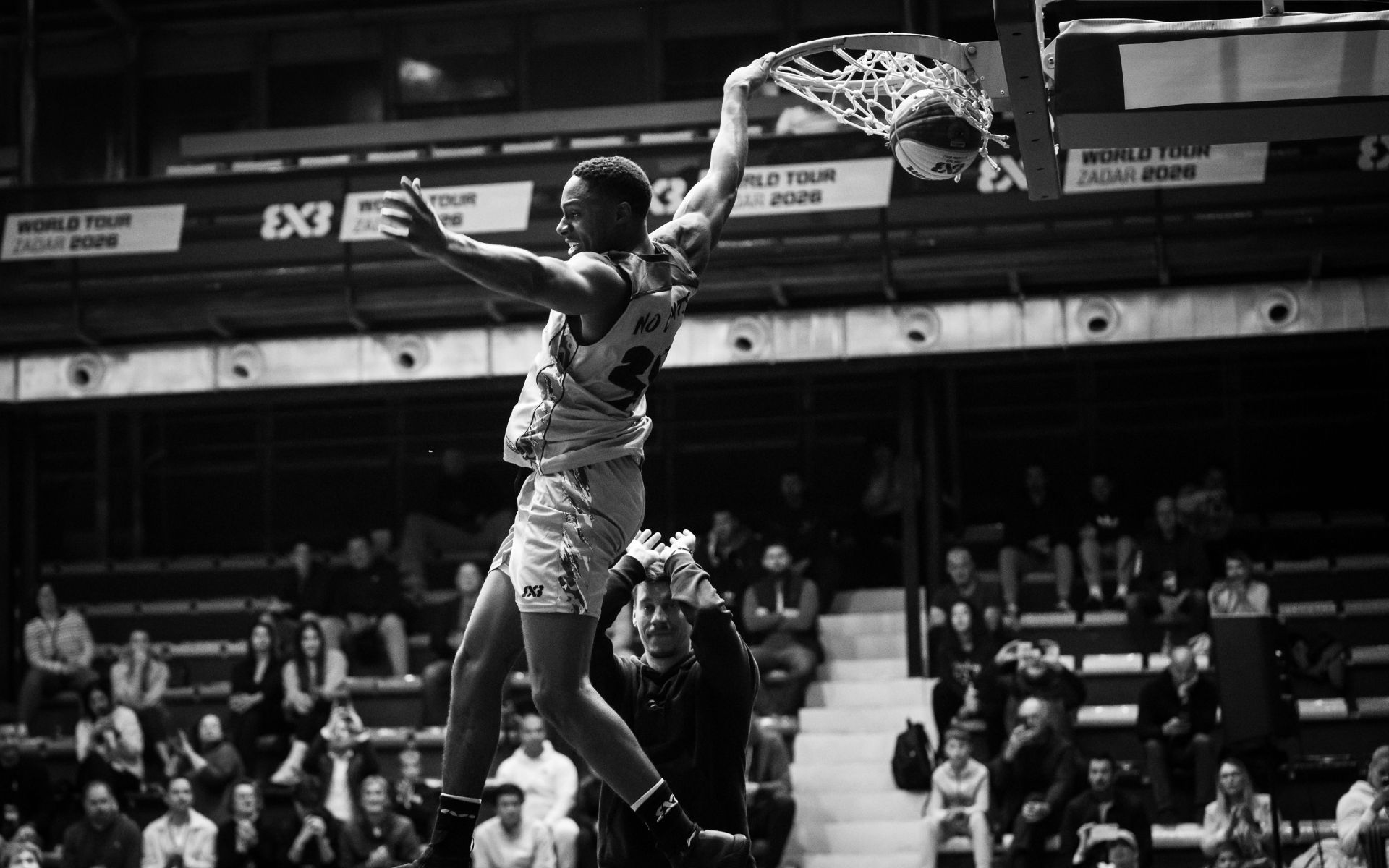
For a long time, I frowned on being called a dunker because I felt like people weren't taking me seriously as an athlete. I saw myself as a hooper first. But eventually I sat back and realised I could probably make more money dunking as a British player than I could playing. My first dunk contest was in Oslo. I won it, and the way I was treated before, during and after that contest made me realise this was something I wanted to do for the rest of my life.
NC: In 2023, you took silver at the FIBA 3x3 World Cup dunk contest in Vienna, on a final dunk that rattled out at the very last moment. What did that day teach you?
JH: That day taught me I needed to put more time into my craft. Around the World Cup I was doing so much, and I wasn't taking time out to be an athlete first, ahead of being a content creator. It's easy to start living off the fruits of it all instead of keeping the foundation in place. I put the loss down to not getting enough reps in on that specific dunk.
It was a real lesson, especially with GB on my back, going up against world-renowned dunkers from America and everywhere else. Making the final against Poland felt like my chance to really show off the dunk I'd created and prove myself at what's essentially the Olympic level of the sport. It stung, but it taught me a lot.
NC: There was a lot of talk after the last NBA dunk contest, when several of the rookies kept missing. Do you think that comes down to reps?
JH: Definitely, but it's not just reps, it's the right reps. A lot of guys can jump high and get their head above the rim, but they don't know how to build a dunk or when to pull a certain one out. Knowing how to structure a run is a massive part of competing, and it's something a lot of these guys just haven't been taught. I always think they should bring someone like me in to help guide them through it, because I know plenty of people who can do incredible dunks on the internet but lose in competition because they don't know how to order them. It's the difference between someone like Mac McClung and everyone else in that field. I know he's coached by the owner of Team Flight Brothers, who's now involved with player relations at DUNKMAN.
NC: You've compared preparing for a contest to a boxer's training camp, studying opponents and adjusting your diet depending on what the contest demands. What does that process look like?
JH: That's exactly what it is, honestly, the closest comparison if you're crossing sports. You're on your own out there, like a boxer. Even my missus knows my whole mood changes once I'm in contest mode, because it's about more than just doing the dunk, you have to defeat your opponent mentally first. It's like Mike Tyson staring into someone's eyes before a fight and knowing he's already got them. I swear, I've beaten people mentally before I've beaten them in the actual contest.
Isolation is a big part of it for me. I cut myself off from everyone, go back to wearing beat-up shoes, that kind of mindset. Meal prep matters too, no sweets, no late nights. Training gets very specific depending on how far out I am from competing. Once I'm in that mode, the fun stops. It's all work.
NC: One of your most talked-about moments is the dunk over a camel in Saudi Arabia. What's the story behind that one?
JH: I'll be honest, I was absolutely terrified. It was a brand expo out in Jeddah, and when we travel somewhere new, we like to pay homage to the culture. Someone said they could get a camel, and once I heard that, my mind went straight to figuring out how to actually pull the dunk off and whether anyone had done it before. Nobody had, so I wanted to be first.
It was outdoors and quite dusty, so I had them sweep the area right before I went, and I needed the crowd in position too. Every detail mattered because if you don't fully commit to a dunk like that, it can go badly wrong. Camels are unpredictable, nothing like a street cat, and you only get one real chance to jump over one. It was set up really well in the end, I executed it, everyone loved it, and I got to ride the camel afterwards.
NC: Out of everything you've pulled off, what's your favourite dunk?
JH: I'm biased, so I'll give you two. The one that means the most to me is a dunk I created and landed for the first time in competition, in Switzerland, putting it down in the final to win a FIBA World Tour title. There are a lot of dunkers online who can throw down something incredible on camera, but the real test is whether you can do that same dunk in a real contest, under real conditions, and that moment is one of the most memorable of my career.
The other would be a reverse double-up, jumping over a person. I only recently got over my fear of heights, and jumping over people used to terrify me, even something as small as a stool. I fell out of a tree when I was sixteen, dropped about twenty-five feet down a slope, and it left me scared of heights for years. Landing that dunk for the first time, at Oxford College, felt like a real barrier breaking down.
NC: It's a punishing sport on the body. What's the worst injury you've ever picked up?
JH: I broke my wrist going for a dunk years ago, playing against Woodhouse. That set me back badly, and it's actually the reason I shoot with my right hand now, even though I'm naturally left-handed. I've drilled it so much since then that I'm more accurate with my right at this point anyway. More recently, I picked up an ankle injury at the NBA House event during Ja Morant's contest earlier this year, and that took a long time to heal too.
NC: Is there any point you've thought about walking away from it all, quitting dunking, maybe going back to the pro level?
JH: Genuinely, yes. A few years ago, I nearly quit dunking to join the army. It sounds random, but at the time, I felt like I'd done everything there was to do in dunking, and I was getting bored. I didn't want to just become a character online, chasing content. I wanted to stay myself, and I felt like scaling any further would mean becoming something I wasn't.
I was actually in the process of applying when I had a conversation with my manager. He told me to respect my own decision but to take my time and not rush into anything, because there was more in me. Something clicked after that. I realised I hadn't actually sacrificed everything to scale myself properly in dunking yet, and that if I stopped there, that would become the ceiling for whoever came after me too. So I decided to get more disciplined, cut out the late nights, and really focus on how great I could become at the thing itself. It's paid off ever since.
NC: You launched Bounce Code, a jump training programme, to bring into academies and school curriculums. What gap are you trying to close there?
JH: Young athletes here don't really know how to train or understand their own bodies, and I think that holds us back as a country. When I played AAU in America, kids as young as five were already in a strict strength and conditioning routine, which is exactly why they're dunking at fifteen. We just don't have that culture here. As an explosive athlete myself, I understand the difference between training to play, training for lateral movement, training to jump high, and training to do tricks in the air. I want to give other athletes here the same opportunity to develop that I had to work out largely on my own.
NC: Is there an NBA dunk contest you go back and watch?
JH: LaVine against Aaron Gordon is my one. If you ask me who should have won, that's the hardest question you've asked me all day. Zach deserved the title, but Aaron deserved to win too, and honestly, I wish it had gone to another round, because that's when you really see who the guy is. Some dunkers might have eight great dunks in them, someone else might have twelve, and that extra mile is what separates athletes at that level.
NC: You open DUNKMAN on July 21st against a stacked field, with Shaquille O'Neal as commissioner and a genuine title on the line. What does stepping onto a stage like that mean to you, and what do you want people watching for the first time to take away?
JH: It's an absolute honour just to be approached for something like this. Shaq is a renowned figure, not just as an athlete, and everyone knows he's someone who recognises what's real. For him to come to the UK and tell me he was excited to work with me meant the world. This feels like my chance to show the UK can compete with anyone in the world, including America, on a stage where people always assume the US leads everything.
I want people to take away that if I can do this, they can too. I come from humble beginnings. I couldn't always do the things I can do now, there were people in my own peer group doing things I couldn't even think about attempting at the time. There's another avenue within this sport beyond becoming a pro player, a coach or an official, and I think DUNKMAN is proof of that. It's also given me the chance to build my own IP, something a lot of professional basketball players never get the chance to think about.